
 FR
FR 
- Systems don’t talk to each other.
- Information is scattered.
- People are overworked.
- Customers are left waiting.
What Is ERP?
Enterprise Resource Planning (ERP) refers to a category of software systems that help businesses manage and integrate their core activities—finance, HR, procurement, manufacturing, inventory, logistics, customer relationships, and more—into a unified digital environment.
Rather than juggling multiple applications, ERP creates a central system that allows departments to share information, automate tasks, and operate with real-time visibility.
According to Microsoft Dynamics 365, ERP is designed to “improve productivity and decision-making by integrating financial, operational, and human resources data into one source of truth.“
Oracle, another global leader in ERP, defines it as “a suite of integrated applications to streamline and automate core business processes” (Oracle ERP Cloud).
SAP, widely used by large enterprises, states that “ERP is the digital core of modern businesses, enabling them to operate more efficiently in an increasingly digital economy.” (SAP.com)
For growing and mid-sized businesses, Odoo—a modern, open-source ERP platform—offers a modular and affordable approach to the same integration, especially with the help of local partners like Albendigitech.
ERP, or Enterprise Resource Planning, is a business management system that brings all departments—sales, finance, inventory, HR, marketing, procurement—into one unified platform.
Think of ERP as the operating system of your business: everything works faster, smoother, and with less error. No more jumping between tools or struggling with disconnected data.
With ERP, your accounting talks to your inventory, your sales team sees what’s in stock, and your managers can make better decisions—fast.
“The goal is to turn data into information, and information into insight.”
— Carly Fiorina, Former CEO of Hewlett-Packard
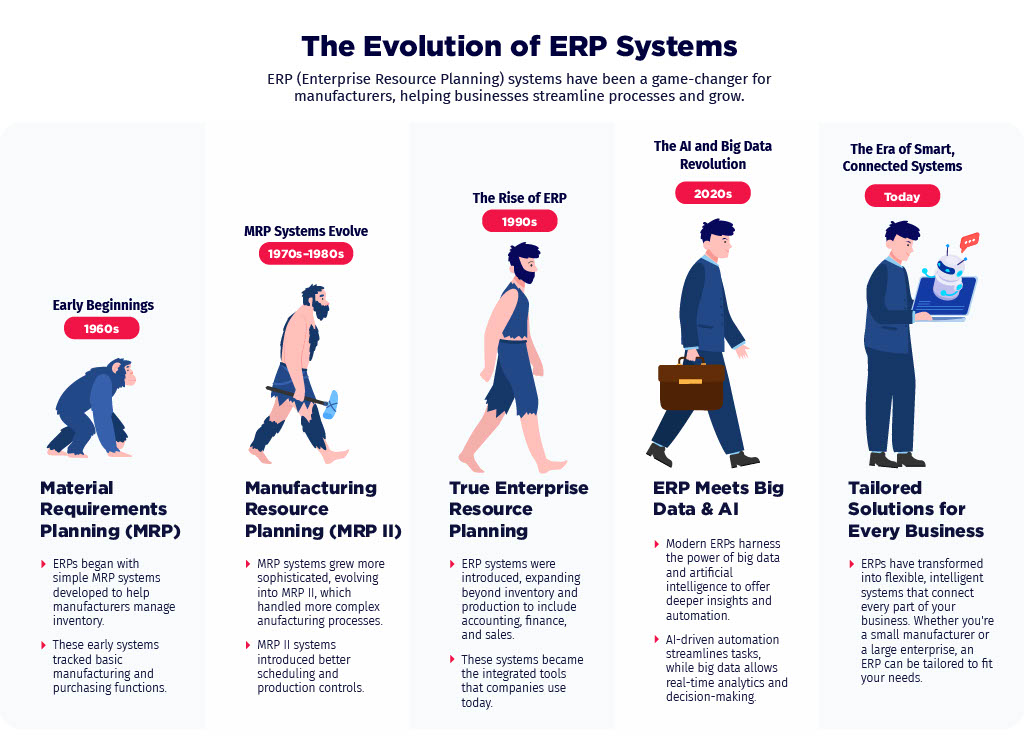
The Journey of ERP
ERP’s story goes back over 100 years. In its earliest form, it was just a paper-based system for scheduling production in factories.
➤ 1960s
Computers entered the scene. Manufacturing companies started using software to manage production schedules and materials—what we now call MRP (Material Requirements Planning).
➤ 1990s
The software evolved. MRP turned into full-blown ERP, linking not just production but finance, HR, supply chains, and more. Businesses across industries began adopting it.
➤ 2000s to Present
Cloud technology changed everything. With faster internet and browser-based access, Cloud ERP became affordable and scalable—perfect for small and mid-sized businesses.
Today, ERP systems are intelligent—they use AI, machine learning, natural language processing, and real-time analytics to help you make smarter decisions, faster.

Why ERP Is a Game-Changer for Modern Businesses
In today’s fast-moving markets, having disconnected tools and manual processes is a recipe for delays, mistakes, and missed opportunities.
Here’s why ERP is critical for any growing business:
 A “Single Source of Truth”
ERP brings all your data into one place, so you avoid duplicate entries, delays, and miscommunication. Whether you're a shop, an eCommerce brand, or a logistics company, ERP gives you clarity and control.
Albendigitech ERP in Partnership with Odoo
We at Albendigitech are proud to offer ERP services in partnership with Odoo, one of the world’s leading open-source ERP platforms. With over 7 million users globally, Odoo delivers enterprise-grade tools—yet it’s accessible and cost-effective for businesses in Benin and West Africa.
This partnership allows us to bring:
Local support with global tools
Customization that fits your market
Affordable pricing with scalable features
Whether you’re just starting or already scaling, our ERP solutions grow with your business.
Key Odoo Applications We Offer
With Odoo’s modular design, you only pay for what you need. Here are some core apps we provide and implement for our clients:
 Sales & CRM
Lead tracking, quotation creation, automated follow-ups.
 Inventory & Warehouse
Smart stock levels, warehouse mapping, real-time tracking.
 Accounting & Invoicing
Auto-reconciliation, multi-currency support, tax compliance.
 eCommerce & POS
Online store integration, payment gateways, barcode scanning.
 Human Resources
Attendance, payroll, leave management.
 Marketing Automation
Campaigns, email newsletters, social media scheduling.
All apps talk to each other in real-time. For example, a sale automatically adjusts stock and creates an invoice—no double entry, no delays.
Real Benefits You Can Expect
ERP is not just a tool—it’s a performance booster. Here’s what businesses have experienced globally:
 Operational Efficiency
 Customer Satisfaction
 Cost Reduction
 Decision-Making Speed
 Data Accuracy
And most important?
Companies that implement ERP report an average ROI of 52%—that means for every $1 you spend, you make $1.52 back in value. (SoftwareSuggest, 2023)
 Frequently Asked Questions (FAQ)
1. What does ERP actually do?
ERP connects different parts of your business—finance, HR, inventory, sales, procurement—so that data flows seamlessly, tasks are automated, and reports are generated in real-time.
2. Is ERP only for large companies?
No. Modern ERP solutions (like Odoo) are designed to scale with your business. Whether you're a startup or a mid-sized operation, ERP can be customized to your size and industry.
3. How is ERP different from regular software?
Unlike standalone apps (e.g., accounting or inventory software), ERP combines multiple tools into one unified system—eliminating the need to switch platforms or duplicate entries.
4. Is cloud-based ERP safe?
Yes. Leading ERP vendors like Microsoft, Oracle, SAP, and Odoo offer enterprise-grade security, encryption, and data protection for cloud ERP platforms.
5. How long does ERP implementation take?
This depends on the size and complexity of your business. Small implementations can take a few weeks, while larger ones may take months. A partner like Albendigitech helps simplify and speed up the process.


Add a Comment